Monday, 31 March 2014
Research: HDD [Day 21/22/23]
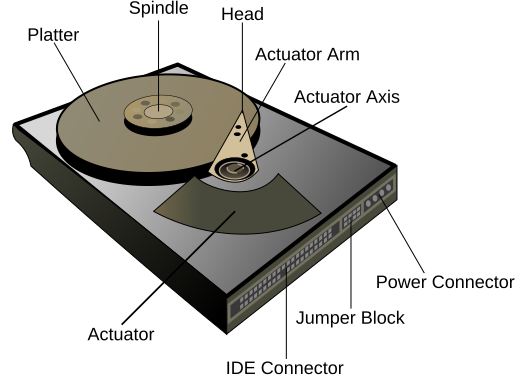
Hard disk drives(HDD) is the hardware that stores all forms of data by using rapidly rotating disks coated with magnetic material.The HDD has 9 major component which are the platter, spindle, head, actuator arm, actuator axis, power connector, jumper block, IDE connector, and the actuator. Unlike RAM, the HDD is able to keep its data even when the power is cut from it. What makes the HDD and RAM alike however, is that it reads the data in a random-access manner. Data recorded by HDD is done by magnetizing a thin film of ferromagnetic material on to the disk. The data is then read by detecting the transitions in magnetization of the disk. Information is being processed as it rotates past the device called read-and-write heads that operates close over the magnetic surface which in turn detects and modifies the magnetization of the material under it immediately.
Tuesday, 11 March 2014
Day 20/21
Day 20: I was assigned to setup a computer for a teacher across the hallway. No problem occurred when hooking up the monitor and PC up in one of the staff's room except making room for the power outlet.
Day 21: Working on a new PC with everything mostly up to date. Had to research the CPU for that computer because it was a Intel Pentium 4 CPU that was running a 64-bit. Installing all the necessary programs needed for a teacher and getting updates for Windows and getting started on researching on hard drives.
Friday, 7 March 2014
Research: CPU [Day 17/18/19]
CPU, which is short for central processing unit, is basically the brain of the computer. It's the hardware within the computer that carries out instructions of computer programs. There are two main components of the CPU which are the arithmetic logic unit(ALU) and the control unit(CU). ALU performs arithmetic and logical operations while the CU takes in the instruction from memory and decodes and execute them, calling on the ALU if needed. A computer is capable of holding more than one CPU and that some integrated circuits(IC) can have multiple CPUs on a single chip which are called multi-core processor. The integer size of the CPU varies and that it sets the hardware limit of the range of integer the software run by the CPU can utilize(Ex: 2^8 or 256 discrete numbers). There is a special storage area within the CPU called register. Before data can be processed, they all must be represented in a register. The number of register that a CPU possesses determines the power and speed of the CPU(Ex: 32-bit CPU is one in which each register is 32-bits wide which means each CPU instruction can manipulate 32 bits of data). The last thing to the CPU is the clock speed/rate. The clock rate is the speed at which the microprocessor executes its instructions. There is a fixed number of cycles to the clock to be able to perform the instruction and with that being said, the faster the clock, the more instructions it can carry out per second.
Tuesday, 4 March 2014
Research: RAM [Day 16]
Random-access memory, otherwise known as RAM, is the memory of the computer used to store data and be accessed directly in any order. Unlike other data storage media such as hard disks and DVD, they read and write data in a predetermined order. There are about 3 types of RAM which are dynamic RAM(DRAM), static RAM(SRAM), and phase-change memory(PRAM). DRAM is used in majority of computers and also has several types of it. There's single data rate(SDR) that's been used before 2002, and there's double data rate(DDR), DDR2, DDR3, where the larger the number, the faster it is to it's predecessor. Contents that are on RAM are the faster than any other type of information storage however the drawback of it is that it loses all of it when the PC is off.
Subscribe to:
Posts (Atom)